
Consent management platforms are one of the most widely deployed pieces of privacy infrastructure on the web. They are also one of the most widely misunderstood. Most organizations treat a CMP as a checkbox deploy the banner, get the cookie notice live, move on. The result is a consent implementation that looks compliant on the surface and fails in ways that regulators, plaintiff firms, and increasingly AI-powered compliance scanners are designed to find.
Done properly, a CMP is not a banner. It is the technical and legal interface between your data collection practices and the individuals whose data you collect. It determines whether your consent is legally valid, whether your advertising technology fires correctly, whether your analytics data is reliable, and whether your organization can demonstrate compliance when a regulator asks. Getting it right requires understanding what a CMP actually does, what the standards it operates within actually require, and where implementations most commonly fail.
This is a practical guide to implementing a consent management platform correctly — covering the foundational requirements, what IAB TCF validation actually means in technical practice, how server-side tagging changes the consent architecture, and the operational disciplines that separate a compliant implementation from one that is waiting to become an enforcement problem.
What is a Consent Management Platform (CMP) and How Does It Work?
Definition: A Consent Management Platform (CMP) is a centralized software system that automates the process of obtaining, recording, updating, and enforcing user permissions regarding personal data processing and cookie storage on digital properties.
A CMP works by performing three core engineering functions simultaneously:
- Signal Collection: It captures granular user choices regarding distinct data processing categories via an interactive client-side user interface (the consent banner).
- Auditable Ledger Storage: It logs those preferences in a standardized, time-stamped, and tamper-evident repository to establish a legal audit trail.
- Downstream Enforcement: It propagates those choices instantly to every analytics script, tracking pixel, behavioral ad server, and third-party widget in the data stack, dynamically blocking or enabling executions based on user choice.
The third function is where most implementations fail. Collecting and storing consent is relatively straightforward. Actually enforcing consent across a complex tag environment — ensuring that a user who declined targeting cookies does not have targeting pixels firing on their session — requires a level of technical integration between the CMP and the tag management system that many deployments never achieve. It’s super complicated and for complex integration systems it’s hard to get right and only a few consent management platforms have managed to truly deliver where as the less mature platforms create large legal risks for faulty cookie banners.
A CMP that collects consent but does not enforce it is not a compliance tool. It is a liability generator creating a record of what users chose while simultaneously violating those choices in the background. Captain Compliance a versatile cookie consent manager that prides itself in respecting users consent choices by properly being configured with their clients websites. The Captain also warns against running a cookie notification that is only a notice and does not tie in with your website and block cookies. Not respecting users consent choices is a dark pattern and causes serious legal and regulatory issues that need to be addressed.
Problems Solved vs. Key Benefits Unlocked by a Compliant Consent Management Platform
Deploying a technically integrated consent architecture addresses critical operational vulnerabilities while unlocking measurable business metrics:
| Specific Pain Points Addressed (Problems Solved) | Strategic Technical Value (Key Benefits Unlocked) |
|---|---|
| Pre-Consent Tracking Lawsuits: Blocks scripts from firing the exact millisecond a user lands on a site, mitigating statutory litigation risks. | Verifiable Audit Readiness: Generates automated compliance logs capable of instantly satisfying regulatory inquiries or vendor due diligence. |
| Asymmetric “Dark Patterns”: Eliminates non-compliant designs that make opting out harder than opting in, eliminating regulatory fines. | Optimized Data Supply Chain: Ensures downstream ad platforms receive uncorrupted, legally valid consent signals, preserving monetization channels. |
| Unmonitored Tag Accumulation: Exposes “shadow tracking” scripts added by unauthorized internal teams or third-party agencies. | Enhanced First-Party Data Trust: Strengthens brand equity by providing transparent, granular control to end-users over their identity. |
What Are the Foundational Requirements Before You Deploy a CMP?
Before selecting or configuring a CMP, organizations must complete two prerequisites that most skip entirely: a comprehensive tag audit and a data flow map.
- The Automated Tag Audit: This process identifies every piece of JavaScript firing on your properties — every analytics tool, advertising pixel, session recording tool, A/B testing platform, heatmap, chatbot, and third-party widget. Most organizations significantly underestimate this number. A mid-sized e-commerce site that believes it has eight or ten tags typically has thirty to fifty when a proper audit is conducted, because tags added by marketing teams, agencies, and developers accumulate without central tracking and without anyone maintaining a definitive inventory. Every tag in your environment needs to be categorized: is it strictly necessary for the site to function, or does it collect personal data for analytics, advertising, personalization, or other purposes? This categorization drives your consent categories and determines which tags must be gated behind consent before they fire.
- The Data Flow Map: This documents what personal data each tag collects, where it sends that data, and what it does with it. This is the information that populates your privacy notice accurately and that regulators will ask for when they investigate a consent complaint. Organizations that cannot produce a current, accurate data flow map cannot produce a current, accurate privacy notice — and a privacy notice that does not accurately describe your actual data collection practices is an independent compliance risk on top of whatever consent failures exist.
How Do GDPR Requirements Shape the User Consent Experience?
The GDPR’s requirements for valid consent are stated clearly in Article 4(11) and Article 7: freely given, specific, informed, unambiguous, and as easy to withdraw as to give. Each of these requirements has direct implications for how a consent banner must be designed and how a CMP must be configured.
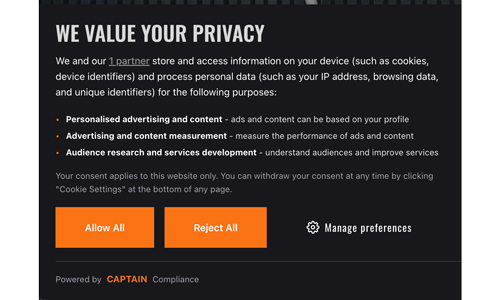
- Freely Given: The user must have a genuine choice. A consent banner that makes accepting all cookies the default and requires multiple steps to decline is not presenting a free choice — it is applying friction asymmetrically to steer users toward acceptance. The EDPB has addressed this repeatedly, and European DPAs have fined organizations specifically for consent banner designs that made declining harder than accepting. Accept-all buttons that are visually prominent, colorful, and placed in the natural click path, paired with decline options that are grey, small, and require navigating to a secondary screen, are dark patterns that invalidate the consent they appear to collect.
- Specific: Consent must be obtained separately for each distinct purpose. A single “I accept all cookies” checkbox that covers analytics, advertising, personalization, and social media tracking simultaneously is not specific consent for each of those purposes. Each purpose category must be presented separately, with a separate opt-in mechanism, so that a user can consent to analytics while declining advertising without being required to accept both or neither.
- Informed: The user must understand what they are consenting to before they consent. The information about each purpose — what data is collected, who it is shared with, how long it is retained — must be accessible at the point of consent, not buried in a privacy policy reachable through a small link at the bottom of the banner. The vendor list for advertising purposes, in particular, must be accessible before consent is given — not just after.
- Unambiguous: The consent signal must be a clear affirmative action. Pre-ticked boxes, continued browsing interpreted as consent, and scrolling past a banner do not constitute unambiguous consent. The user must actively do something — click, toggle, check — to signal agreement.
- Easy to Withdraw: Your CMP must provide an accessible mechanism for users to revisit and change their consent choices at any time. A consent preferences link in the footer that reopens the CMP is the standard implementation. That link must be present on every page, must be functional, and must actually update the consent signals in the downstream technology stack when a user changes their preferences — not just update the stored record while the tags continue firing as before.
What Does IAB TCF Validation Mean in Technical Practice?
Definition: The Transparency and Consent Framework (TCF), engineered by IAB Europe, is a standardized technical standard that encodes user consent preferences into a compressed base64 string (TC String) and distributes it across the digital ad tech ecosystem using a global runtime API.
Step-by-Step Technical Execution of an IAB TCF Signal
- Initialization: The CMP initializes on the webpage and exposes the standardized global JavaScript API namespace via the __tcfapi object.
- String Generation: When a user selects their granular privacy preferences, the CMP instantly maps these inputs against the active Global Vendor List (GVL). It serializes these choices alongside metadata (e.g., timestamp, CMP ID, GVL version) into a standardized binary format, which is then converted into a base64-encoded TC String.
- Client Storage: The generated TC String is written to a compliant first-party cookie labeled euconsent-v2 and mirrored within browser localStorage.
- Downstream Broadcast: Third-party ad tags and supply-side tools execute an asynchronous call to __tcfapi(‘addEventListener’) or query the string directly. The script reads the permissions encoded inside the string before deciding whether to initialize tracking mechanisms or drop targeted advertising identifiers.
Critical Points for Successful TCF Validation
- TC String Structural Verification: A TC String that is malformed, truncated, or incorrectly encoded will be rejected or misread by downstream vendors. Vendors that cannot parse the TC String correctly may default to firing without consent — or may block entirely, breaking advertising revenue.
- Active Global Vendor List (GVL) Syncing: Your CMP must be configured with a current version of the GVL — an outdated vendor list means your consent banner may not be presenting consent requests for vendors who have updated their declared purposes, and may be presenting consent requests for vendors who are no longer active. The GVL is updated regularly and your CMP configuration should be reviewed whenever significant updates occur.
- Handling Non-Registered TCF Vendors: TCF only covers IAB-registered vendors. Non-registered vendors — including some analytics tools, session recording platforms, and custom advertising integrations — cannot receive consent through the TC String. They must be handled through separate consent mechanisms outside the TCF framework.
How Does Server-Side Tagging Change the Consent Architecture?
Server-side tagging (SST) changes data flows by eliminating the direct link between the client browser and third-party ad networks, acting as a controlled cloud-based proxy.
| Architecture Layer | Traditional Client-Side Tagging | Modern Server-Side Tagging (SST) |
|---|---|---|
| Data Transmission | The browser directly transmits user data payloads to dozens of external third-party endpoints simultaneously. | The browser sends a unified data stream to a secure, first-party cloud server managed by the website owner. |
| Consent Enforcement | Handled client-side by attempting to block scripts from running inside the user’s browser runtime. | Handled server-side by checking the event data layer payload and filtering out or dropping outgoing data streams before they leave the server. |
| Privacy Control & Data Masking | Low control. Third-party scripts can freely read browser configurations, IP addresses, and device fingerprints. | High control. The proxy server strips PII, hashes identifiers, and obfuscates IP addresses before forwarding filtered data. |
| Regulatory Focus | High litigation risk due to visible pre-consent pixel firing visible in browser developer tools. | Reduces visible wiretapping claims but demands strict server logs showing consent decisions gate the cloud router. |
The technical implementation requirements for SST consent enforcement: Consent signals from the client-side CMP must be captured in a first-party data layer event and passed to the server-side container with every hit. The server-side container must have explicit tag firing conditions based on those consent signals — one configuration for consented users, a different configuration for non-consented users. Vendor forwarding must be tested under both consent states to verify that declining users do not have data forwarded to advertising or analytics vendors. And the consent logging architecture must capture server-side forwarding decisions alongside client-side consent records so that the audit trail is complete.
Field-Tested Best Practices for Long-Term CMP Governance
- Establish Pre-Deployment Tag Gateways: Enforce an operational policy requiring privacy team approval before marketing or engineering can add new tracking scripts to production tag managers.
- Automate Weekly GVL and Vendor Audits: Set a recurring schedule to check your CMP vendor list configuration against the latest IAB Global Vendor List directory to eliminate deprecated data processing purposes.
- Monitor Consent Rate Anomaly Triggers: Watch for sudden drops or spikes in opt-in metrics. A sharp deviation typically signals a broken script, an unmapped tag, or a browser-level privacy blocker overriding your layout.
- Conduct Continuous End-to-End Signal Validation: Use automated scanners or manual proxy tools to test that opting out of a category on the cookie banner immediately halts the underlying network requests in the network panel.
What Good Privacy Compliance Looks Like
A properly implemented CMP is one where every tag in the environment has been inventoried and categorized, the consent banner presents clear and specific choices for each purpose category with no asymmetric friction between accepting and declining, TCF strings are correctly structured and validated, consent signals propagate correctly to all tag firing conditions including any server-side container, non-TCF vendors are handled through separate consent mechanisms, consent records are logged in auditable form, a consent preferences link is accessible on every page, and there is an operational process that requires review whenever new tags are added or vendor lists change.
That description sounds straightforward. The gap between it and what most organizations actually have deployed is where enforcement actions originate, where deals stall in vendor due diligence, and where advertising revenue is being lost to consent implementation errors that could be fixed with a proper audit.
Consent management done properly is not an obstacle to business operations. It is the infrastructure that makes data-driven business operations legally sustainable.
Frequently Asked Questions Regarding Cookie Consent and CMP Compliance
Can a business rely on a privacy policy link in the footer instead of displaying an active cookie banner?
No. Regulatory standards like the GDPR explicitly require unambiguous, affirmative consent before any non-essential data processing or cookie placement occurs. A passive link in the page footer fails the legal threshold for an explicit opt-in action.
Does server-side tagging remove a company’s obligation to collect user consent?
No. Moving data collection tracking logic from a user’s local browser to a secure cloud server alters the technological network pathway, but it does not change the core legal obligation. Tracking user behavior and forwarding that data to downstream ad networks requires valid consent regardless of whether the transfer happens on the client or server side.
What happens if a web tag fires before a user interacts with the consent management platform banner?
This creates immediate legal exposure under modern wiretapping statutes and consumer protection frameworks. Any non-essential data transmission occurring before the user provides an explicit affirmative signal is considered an unauthorized collection of personal information.
How often must website operators renew user consent selections under the IAB TCF framework?
While specific regional authorities offer varying timelines, a standard best practice is to renew consent selections every 12 months. Furthermore, major updates to the Global Vendor List (GVL) or core policies require the interface to collect updated consent choices from users.
Assess Your Consent Management Implementation Today
Top Business Software provides a directory of the very best consent management companies in the SaaS marketplace. So you can make an informed decision when purchasing a CMP for your organization in our data privacy management software comparisons section. There we provide 3rd party user reviews on companies like Captain Compliance, OneTrust, Ketch, MineOS, Usercentrics, CookieBot, and many others. As our guide detailed it’s important to find a solution that provides CMP audits, TCF validation assessments, server-side tagging consent, and expert-led implementation programs built to close the gap between what your consent banner collects and what your technology stack actually enforces.
Related Categories