
Cloud Marketplace Deals Move Slowly, and It Shows
Selling software through AWS Marketplace, Azure Marketplace, or Google Cloud Marketplace should be simple. A buyer wants your product, they have committed cloud spend to burn down, and the marketplace handles procurement. In theory, everybody wins.
In practice, the deal process is full of manual steps that add days or weeks to the sales cycle. An account executive closes the deal verbally, then hands it off to an ops team that creates a private offer in the cloud provider’s portal. That offer has to match the negotiated pricing, payment schedule, and contract terms exactly. If anything is off, it bounces back. Meanwhile, the co-sell opportunity needs to be registered with the hyperscaler’s partner team so the deal gets field support. That registration happens in a separate system. Once the buyer accepts and the contract is live, someone needs to reconcile the revenue against what the CRM says. None of these steps talk to each other automatically in most companies.
This is why cloud marketplace deals that should close in two to three weeks often take six to eight. The sales conversation moves fast, but the operational plumbing behind it doesn’t keep up.
Where does Cloud Sales Motion slow down
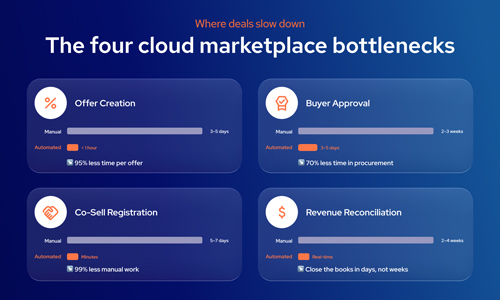
When you break a marketplace deal into its individual steps, four stages tend to absorb the most time. Cloud sales automation platforms like Clazar exist specifically to compress these stages, so it helps to understand where the drag comes from.
Offer creation is the first. Most sales teams can’t generate a private offer from their CRM. They log into the cloud provider’s portal, manually enter pricing and terms, and hope nothing was lost in translation from the CRM opportunity. For complex deals with custom payment schedules or multi-year terms, this can take 30 minutes to an hour per offer, and errors mean starting over.
The second is co-sell registration. Hyperscaler co-sell programs (AWS ACE, Azure IP Co-Sell, GCP Partner Advantage) require you to register deal details with the cloud provider’s partner team. When this is done manually, reps spend 10 to 15 minutes per opportunity to fill out forms and copy data from the CRM into the partner portal. At scale, a team registering 50 co-sell opportunities a month is losing over 12 hours to data entry alone.
Buyer approval lag is the third bottleneck. Once a private offer is sent, the buyer needs to accept it in the marketplace console. If there are discrepancies between what was discussed and what appears in the offer, this creates back-and-forth that stalls the deal for days.
Lastly, revenue reconciliation. After the deal closes, finance teams need to match marketplace payouts against CRM records and internal billing systems. Without a direct data feed, this is a manual spreadsheet exercise that delays revenue recognition.
What Cloud Sales Automation Changes
Cloud sales automation compresses each of those stages by connecting the CRM, the cloud marketplace, and the partner portal into a single workflow. The sales rep stays in Salesforce or HubSpot. The operational steps happen in the background.
With Clazar, for example, a rep can create a private offer across AWS, Azure, or GCP directly from a CRM opportunity. Pricing, terms, and payment schedule are pulled from the deal record, so there’s no manual re-entry. Co-sell opportunities auto-register with the hyperscaler’s partner portal based on CRM deal updates, which means the field team at AWS or Microsoft gets visibility into the deal without anyone filling out a separate form. And when the buyer accepts, revenue data syncs back to the CRM and finance systems automatically.
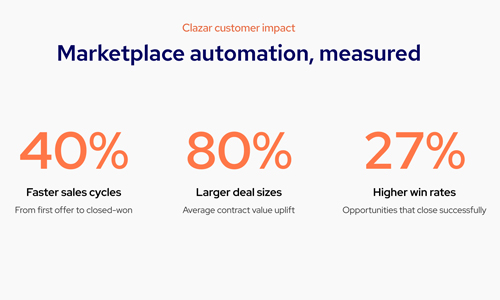
The cumulative effect on deal velocity is measurable. Clazar’s customer data shows 40% faster sales cycles, 80% larger average deal sizes (because reps can handle more complex multi-cloud deals without operational drag), and 27% higher win rates. Those numbers come from removing the friction between the sales conversation and the operational machinery that executes the deal.
The Compounding Effect on Pipeline
Faster individual deals matter, but the pipeline effect matters more. When deal execution takes six to eight weeks, reps can only run a limited number of marketplace deals simultaneously before ops becomes the constraint. Shortening that cycle means more deals can move through the pipeline in the same quarter.
The State of Cloud Marketplace & Co-Sell Report from Clazar and Partner Insight found that 89% of SaaS companies transact on at least one cloud marketplace, but only 22% generate meaningful revenue through these channels. One of the clearest differences between the two groups: the top 22% are twice as likely to have automated their marketplace operations. They also engage hyperscaler field teams at much higher rates (94% versus well under half for the rest), which is a direct result of having co-sell registration automated rather than relying on manual processes that get deprioritized when the team is busy.
What to Look For in a Cloud Sales Automation Platform
If you’re evaluating cloud GTM platforms, a few capabilities separate the ones that actually speed up deals from the ones that just add another dashboard to manage.
CRM-native deal execution is the biggest one. If your reps have to leave Salesforce or HubSpot to create offers or register co-sell opportunities, you’ve just moved the manual work from one screen to another. The platform should let reps manage the entire cloud deal lifecycle from their existing CRM, with bidirectional sync so every update flows both ways automatically.
Multi-cloud support also matters, as most ISVs sell through at least two of the three major marketplaces. If your cloud sales automation tool only covers AWS, you’re still running manual processes for Azure and GCP deals, which defeats the purpose.
And look at the pricing model. Some legacy platforms take a percentage of your marketplace revenue, which means your costs scale with your success. Others, including Clazar, charge a flat rate. At higher deal volumes, the difference becomes significant.
Why Speed is a Competitive Advantage in Cloud Sales
Cloud marketplace transaction volume is growing, and enterprise procurement teams are increasingly defaulting to cloud marketplace purchasing. The companies that can execute cloud marketplace deals quickly and reliably will close more of this expanding spend.
For ISVs and SaaS companies serious about cloud revenue, automating the deal execution layer is one of the highest-ROI investments available right now. The math is simple: fewer manual steps, faster cycles, more deals closed per quarter.
SME Q&A

CEO & Co-Founder, Clazar
Where do you see the most time wasted in cloud marketplace deal execution?
The handoff between sales and Revops/Deal-desk team. A rep closes a deal, and then someone has to manually recreate it as a private offer in the cloud marketplace portal. That translation step is where errors happen, and errors mean rework. We’ve seen companies where a single private offer takes three or four attempts before it matches what was actually negotiated. When we built Clazar, the goal was to eliminate that handoff entirely so the offer can be generated directly from the CRM record.
How much faster do cloud sales deals actually close with automation?
Our customer data shows about 40% shorter sales cycle. But the more interesting number is what happens to deal volume. When ops stops being a bottleneck, reps can run more marketplace deals concurrently. We have customers who doubled their marketplace revenue within two quarters of automating, and the headcount on their ops team stayed the same.
What advice would you give to a SaaS company just starting to sell through cloud marketplaces?
Figure out what can be automated and automate from day one. The biggest mistake I see is companies that build a manual process first, plan to automate later, and then get stuck because the manual process becomes load-bearing. At that point, you’re migrating under pressure, which is harder. If you start with automation, your operations scale with your deal volume instead of against it.
Related Categories