
Your bestseller is listed at $49.99 on your official website for all locations, only a currency is different. A number of shops in different countries offer what looks like the same product for what is equivalent to $29.99. Yet you do not know about any of those offers – because the monitoring tools you use cannot overcome location barriers and will not show such offers on dashboards. This creates a visibility gap, which costs businesses over $500 billion annually, according to OECD.
Why is visibility so pivotal?
Visibility – not the general awareness that the forgery problem exists, but the accurate information on what specific listings are active, on what websites, and in what regions – is the key to fighting counterfeits.
In the queue, counterfeits are not solely a retail problem – it touches brand reputation and image safety, legal aspects, and operational issues as well. Visibility benefits any business in more than one aspect.
Why is it hard to detect counterfeits?
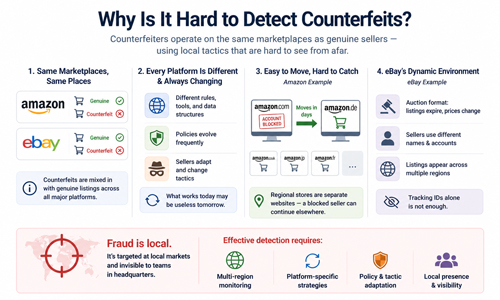
Counterfeits are sold on the same marketplaces where genuine goods are present – Amazon, eBay – and in the same locations. The problem is that all websites have specific monitoring challenges, which means that what works for one platform is useless for others. Besides, policies evolve, as well as schemes to avoid detection, so companies need to stay on constant alert.
For example, Amazon has numerous regional stores – amazon.de, amazon.jp – which are technically separate websites. A seller that was blocked on amazon.com can move to a regional website in a matter of days and continue there.
eBay uses an auction format, when offers expire, prices change, and sellers use different names across regions to further cover tracks. Tracking their IDs alone is not enough. Detection is tough in such circumstances.
The hardest thing about all those websites is not that there are millions of offers – with modern tools, it is not impossible to keep track of them. The hardest part is that fraud is local – targeted at the local markets and invisible to teams in headquarters from across the ocean.
Why location matters for counterfeit detection?
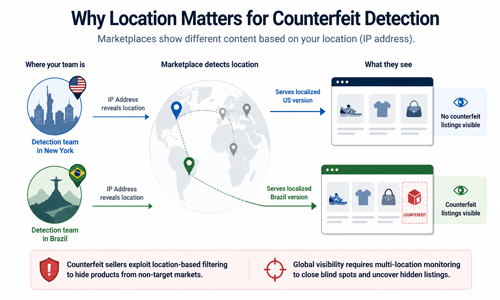
Monitoring setups often miss one important aspect: marketplaces automatically detect visitors’ location and serve localized versions of platforms. When users are online, their IP address – a numerical identifier of the device – is visible to websites. IP addresses are tied to internet service providers and cellular operators, meaning they give away one’s location.
This way, a detection team located in New York can only see a US version of platforms, staying oblivious to European or Brazilian versions.
Counterfeit sellers know that fact, as well as the locations of protection teams. They deliberately restrict their listings to appear only to users who browse from the target-market IPs. Technically, for other users who look from other areas, such products do not exist at all.
Such a scheme may sound like something simple, obvious, and thus easy to stop. In reality, it is a widespread, even standard model that is actively in use. It works especially well for markets where there are blind spots in laws and delays in enforcement, like Southeast Asia or Latin America.
How to close the visibility gap in counterfeits detection?
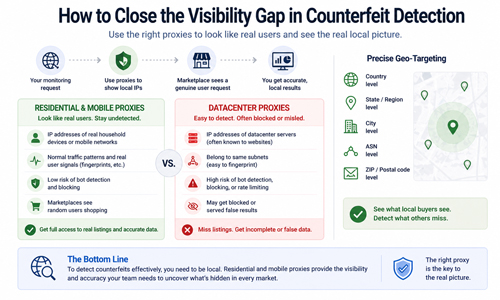
The fix is manageable – requests have to show the IPs of the locations where you are trying to monitor the markets. To make it possible, proxies are used. However, not all proxies are effective – it has to be residential or mobile IPs, not datacenter.
The thing is that marketplaces rely on active and sometimes aggressive bot detection. Bots may be a sign of an upcoming attack or competitors trying to analyze you and find weaknesses, so bots are generally blocked right when detected. So, it is necessary to make your detection activities look like genuine users browsing.
Residential addresses are IPs of household devices, used by real people. They have normal traffic patterns and other signals like fingerprints that collectively create an “ordinary user” look. The same goes for mobile proxies – addresses assigned by cellular operators when you go online using a mobile network. Both types prevent bot detection systems from flagging requests as suspicious. To marketplaces, requests that originate from such addresses look like random users shopping.
Datacenter IPs are addresses of datacenter servers, probably even known to websites. They often belong to the same subnet, meaning they only differ in one or two digits, which makes them easier to detect. If not instantly blocked, they are often served false results.
Residential or mobile proxies, at the same time, allow for precise geo-targeting on a country, state, city, ASN, and ZIP levels. This is a tool that provides a path to markets and allows other monitoring tools to see not the general, but the real local picture.
How to use proxies for effective counterfeit detection?
The most important aspect is that proxies must be ethically derived. The thing is that when you connect to the proxy server, it sees your real IP address and location. It may seem like nothing much, but for hackers with tools at hand, it may open a door for more information. For example, they can scan for open ports and try to hack your system. You never know who is behind free or illegal proxies and how your data may be used. Besides, getting involved with IPs that are associated with any fraudulent activities may lead to reputational damage. GDPR-compliant, ISO certified proxies are the best choice.
Next, it is just as important to use proxies according to the terms of service of the websites you are inspecting. Note that policies often change, even without prior notice. In order not to be flagged even with proxies, respect the platforms’ requirements.
Choosing the right type of proxies is another attention-worthy step. It may feel confusing to decide between residential and mobile proxies, as both types offer high anonymity and are hard to detect. Residential proxies are tied to real users, while mobile IPs are used by a lot of people simultaneously, and it is hard to detect who does what. That is the reason websites rarely ban them, so mobile proxies are suitable for sources that are the toughest to scrape. At the same time, both types rely on real device connections, meaning that if a user goes offline, a proxy becomes unavailable too. Mobile IPs are also often reassigned – when a user moves between the coverage areas of different towers – which may add some instability to the connection, but not necessarily.
For your convenience, there is a short comparison table.
| Type of proxy/criteria | Residential | Mobile |
| Anonymity | Anonymous | More anonymous |
| Reliability | More reliable | Reliable |
| Detection | Hard to detect | Hard to detect |
| Price | Expensive | More expensive |
There is an important rule: if you are dealing with mobile-first apps and platforms, go for mobile proxies. If you are about to get involved with desktop versions and apps, residential proxies are the choice. As your goal is to give an impression of a real user, such incoming conditions are important.
Also, both residential and mobile proxies are a bit costly, but it depends heavily on the provider. Vendors like DataImpulse offer pay-per-GB models with non-expiring traffic, meaning that you pay only for GBs used.
Geo coverage is also important as it directly influences whether you will be able to reach local markets. For example, the aforementioned DataImpulse offers proxies in 195 locations, meaning no local markets would stay away from your attention.
Conclusion
Visibility may seem too obvious, yet it is what makes or breaks counterfeit detection. Proxies are what help businesses stay invisible to fraudsters and uncover counterfeits. When chosen according to the use case and used in legal ways, they are a good booster for detection setups.
FAQ
Do proxies offer 100% anonymity?
No, proxies alone cannot provide full anonymity. However, when paired with other tools, they boost privacy levels and monitor markets without raising suspicions.
What proxies to choose for counterfeit detection?
Counterfeit detection calls for highly anonymous proxies like residential or mobile. The final choice depends on a specific use case – if you deal with mobile apps or platforms, go with mobile IPs. If you target browser apps, opt for residential IPs.
Is using proxies legal?
Yes, it is legal if you opt for ethical vendors and act within the websites’ policies. Remember to check those policies, as they may change without notice.
Can I use proxies with other monitoring tools?
Yes, proxies can be integrated with numerous tools to ensure smooth access across locations. The exact setup process depends on the tools you use and the proxy vendor you choose.
Related Categories