
You get a quote for CLM software. The platform fee is $50,000 a year. Your CFO approves the budget. You sign the contract.
Eleven months later, you run the numbers. You’ve spent closer to $95,000.
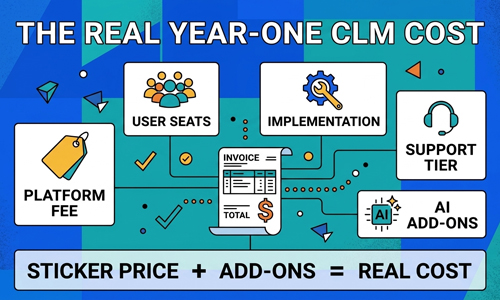
The vendor didn’t mislead you. The platform fee covered the platform. Implementation was a separate engagement. The support tier you needed turned out to be an upgrade.
The AI module your team demoed was priced as an add-on. And when marketing and finance asked for access too, the per-seat line grew.
This gap between sticker and total is the standard CLM buying experience. Data from procurement services like Vendr puts typical first-year Ironclad spend at $75,000 to $200,000 against a platform fee of $30,000 to $150,000.
The platform fee almost never tells the real story.
What follows is a category-by-category framework for building the year-one number yourself, before you sign, so the quote on page one of the proposal resembles the invoice in month twelve.
The Base Platform Fee Is Not the Base
The platform fee is the number vendors lead with. It covers core features at the tier you select, some storage, and a capped number of user seats. It doesn’t cover much else.
A few CLM vendors publish their pricing openly. ContractSafe publishes its three plans starting at $450 per month, so you can see what each tier costs before you ever talk to sales.
Most enterprise CLM vendors don’t. Ironclad’s pricing page in 2026 still directs buyers to request a custom quote.
Before you budget against a platform fee, get the vendor to show you in writing what it actually covers at the tier you’re being quoted, and what requires a separate line item. Get that list before anything else.
The Per-User Pricing Trap
This is the biggest TCO variable most buyers underestimate.
Most enterprise CLM vendors charge per seat, in a range of $30 to $80 per user per month at scale, according to Vendr’s marketplace data on Ironclad.
At 30 users and $50 per seat, that’s $18,000 a year in seat licenses. At 100 users, it’s $60,000. The platform fee didn’t change. The bill tripled.
Dave at Simple Contract Management has documented the per-user math from direct experience at sub-500-employee companies.
His observation: contracts touch a lot of people relative to company size. Sales needs to see client agreements. Finance watches vendor terms. HR has employment contracts. The auditor needs read-only access once a year.
In a 100-person company, that’s 15 to 20 people who need some level of platform access.
The worse outcome isn’t the full bill at the high end of per-user pricing. It’s that you cap yourself at five seats instead of twenty.
Marketing can’t see the contract with their own agency. Finance can’t check a vendor term without emailing legal.
The access silos the CLM was supposed to eliminate get recreated in software, and you paid for a platform to buy back the original problem.
ContractSafe’s flat pricing removes the variable. Unlimited users on every plan.
Your finance director can check a vendor agreement without asking permission. The auditor can log in during audit season without anyone buying a temporary seat. You pay the same bill whether five people use the platform or fifty.
Ask every vendor the same question: how does the bill change if we add ten users? What about fifty?
Implementation Is Where the Real Money Moves
The platform fee is negotiable on the margins. Implementation is where the actual money moves.
Market data on Ironclad shows implementation fees landing between $5,000 and $50,000, which is why first-year spend routinely runs 1.5 to 2 times the platform fee alone.
The line item covers configuration, data migration from whatever legacy system your contracts currently live in, workflow setup, integration work, and user training.
Vendors handle this category differently. Some require a professional services engagement before go-live. Others offer a DIY path but push you toward professional services during the sales cycle. A few include implementation in the base subscription.
This is where ContractSafe’s pricing model differs structurally from most enterprise CLM vendors. Implementation, data migration, and a dedicated customer success manager are included in every plan at no additional charge.
There’s no separate statement of work for go-live, because go-live is part of the subscription.
If a quote shows a $0 implementation line, ask why. It’s either included, or it’s a discount that won’t survive renewal. You want to know which one before you sign.
Support Tier Upgrades
Enterprise software ships with a base support tier. Faster response times, dedicated contacts, and extended hours are usually upgrades. Most buyers find this out the first time they actually need help.
Things to confirm before the contract gets signed:
- What’s the response time SLA at the base tier, not the premium tier in the sales deck?
- Is a dedicated contact included, or does that require a higher plan?
- What are the support hours: business hours, 24/5, or 24/7?
- Is customer success included in the subscription or billed separately?
Vendors aren’t wrong to charge for tiered support. Enterprise-grade coverage costs money to staff. But you need to know which tier you’ve actually bought before the first outage, not during it.
A dedicated customer success manager is standard on every ContractSafe plan. Most competitors treat dedicated CSM access as an upsell.
AI Is the Fastest-Growing Line Item
AI contract review, AI drafting, risk scoring, and advanced analytics are standard buyer expectations now. Most enterprise vendors sell them as modules on top of the base platform.
Pricing data on Ironclad shows AI add-ons running 20 to 30 percent above the base fee.
The demand is coming whether your budget is ready or not. The Deloitte 2026 State of AI report found that 74 percent of companies plan to deploy agentic AI in contracts within two years.
If AI is a core capability for your team and not a nice-to-have, price it into year one. If you wait until year-two renewal, you’ll be negotiating with your team’s workflows already built around the feature.
AI features sit on Maximize at $815 per month without a separate AI module SKU on the ContractSafe side. On vendors with module-based AI pricing, assume a double-digit percentage uplift and negotiate it into the initial contract.
Renewal Increases and Volume Overages
Enterprise CLM vendors routinely raise rates at renewal, sometimes by double digits. Vendr’s data on Ironclad shows renewal increases that can turn a $50,000 year-one contract into $65,000 by year three without any new usage added.
Some vendors also meter contract volume, storage, or API calls. Overage charges don’t appear in year-one quotes but surface once adoption ramps.
Negotiate two things into the initial contract: a renewal rate cap in writing (3 to 5 percent annual maximum is a fair benchmark), and a clear definition of what triggers overage charges.
Without a cap, the vendor reprices every year based on what the market will bear. Without a definition, you find out what “excess usage” means the same month the invoice arrives.
Build Your Year-One Budget
Decompose every quote you get into these categories:
- Platform fee at the tier you actually need, not the introductory tier.
- Per-user costs at your actual headcount with access, not the minimum seat count in the quote.
- Implementation services as a separate line, even if the vendor bundles it.
- Support tier at the level that gets you real help.
- AI and feature add-ons for any capability your team plans to use.
- Integrations above the baseline for any system the CLM needs to talk to.
- Renewal rate cap and overage triggers negotiated into the initial contract.
Here’s how a $50,000 platform quote decomposes when you apply this framework to the scenario that opened this article:
| Line Item | Year-One Cost |
| Base platform fee | $50,000 |
| 30 users at $50/month | $18,000 |
| Implementation engagement | $15,000 |
| Support tier upgrade (dedicated CSM) | $10,000 |
| AI module | $12,000 |
| Year-One Total | $105,000 |
A flat-pricing CLM that includes implementation, support, and AI in the subscription would land closer to $10,000 for the top tier plus migration.
That’s not a fair head-to-head for every use case. Enterprise platforms do things flat-pricing platforms don’t.
But it’s the comparison you need to run before deciding which tradeoffs actually fit your team. ContractSafe’s alternatives page walks through the category for teams running this math.
What You Should Walk Away With
Transparent pricing isn’t automatically cheaper. It’s just closer to the real number. Vendors whose published price equals their delivered price are vendors whose math you can verify.
Vendors whose year-one total runs two times the sticker aren’t automatically the wrong choice. You just need to walk in knowing that’s the shape of the deal.
Not find out at year-end when your CFO asks why the contract management line item doubled.
Ask for the line items. Run the sample calculation. Decide which tradeoffs fit with the real number in front of you.
Related Categories