The executive summary
Enterprise software estates are now changing faster than enterprises can verify them, and most of that change was not written by your own teams. The cost of quality has quietly restructured itself around this fact, and its largest component, the cost of delay, appears on no budget line anywhere. The organizations getting ahead of it are treating verification as a governed, continuous capability that produces evidence of release readiness, rather than a phase at the end of a project plan.
The change you did not write
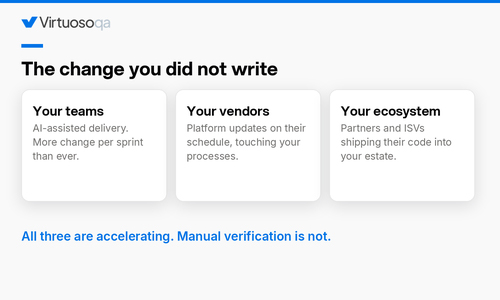
Ask where change enters a typical enterprise estate and three sources dominate, and only one of them is under your roadmap’s control.
The first is your own delivery organization, now AI-assisted and producing more change per sprint than at any point in its history. The second is your platform vendors. If you run enterprise platforms for CRM, ERP, HR, finance or service management, updates arrive on the vendor’s schedule, several times a year, touching the configurations and customizations your business processes actually run on. Increasingly, some of that vendor code was itself written by AI systems nobody in your organization hired or approved. The third is your delivery ecosystem: implementation partners and ISVs building on top of those platforms, each shipping their own change into your estate.
Every one of those sources is accelerating. Your capacity to verify what they change, if it still depends on people manually authoring and maintaining tests, is not. That gap is the new release risk, and it compounds every quarter it goes unaddressed.
What does the cost of quality actually consist of now?
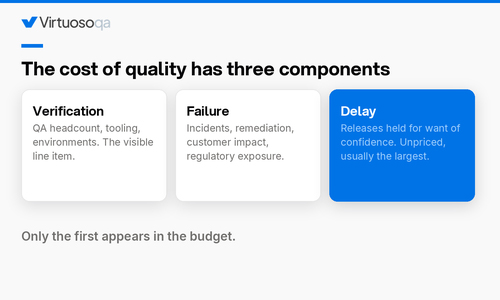
The cost of quality has three components, and most organizations only budget for the first.
| Component | What it is | Where it hides |
|---|---|---|
| The cost of verification | QA headcount, tooling, environments | The visible line item, the only one that gets budgeted |
| The cost of failure | Production defects, remediation, customer impact, regulatory exposure | Incident budgets, war rooms, and in regulated industries, the compliance file |
| The cost of delay | Every release held back for want of confidence; every program padded to fit a multi-week regression cycle | Nowhere. It is business value postponed, and it is usually the largest of the three |
When a board asks why the AI investment has not translated into delivery speed, the cost of delay is usually the answer nobody has quantified. The three components trade against each other: cut verification spend and failure costs rise; protect against failure with longer test cycles and delay costs rise. For decades that triangle was treated as a law of nature. It is actually a property of one assumption: that verification effort scales with human hands.
Software testing platforms such as Virtuoso QA challenge this traditional trade-off by combining AI-assisted test creation and maintenance with deterministic execution and human oversight. This approach helps organizations reduce the manual effort involved in verification while maintaining the evidence and confidence needed to release software without unnecessary delays.
Why headcount cannot close the gap
A linear function cannot track a compounding one. If change volume grows 40% a year and each unit of change requires human verification effort, the QA budget must grow 40% a year forever just to stand still. No CFO signs that curve, so what actually happens is quieter: coverage erodes, confidence is asserted rather than evidenced, and risk accumulates off the books until an incident puts it back on them.
The structural answer is to change what humans spend their effort on. AI agents now do the volume work of verification, reading specifications, generating test coverage, proposing repairs when applications change, at machine speed. Deterministic execution makes the results reproducible. And people hold the decisions: what enters the test estate, what changes, what ships. The operating principle is that AI proposes and humans govern, and the discipline matters as much as the technology. Named individuals approve consequential steps, and every decision leaves a record, because “the system decided” satisfies neither a regulator nor a post-incident review.
This is the operating model Virtuoso QA has put into production with Touchstone, the platform’s agentic assurance layer, and it changes the economics of the triangle rather than picking a corner of it.
What happens to the numbers when verification stops being the constraint
The pattern across enterprises that have made this shift is consistent: verification cost falls, coverage rises and delivery accelerates at the same time, three outcomes the old model treated as mutually exclusive.
A global insurance group completed a cloud migration across policy, claims and settlement in four months against six planned, with 100 end-to-end business processes now verified daily rather than periodically. An international industrial services group took an ERP regression cycle from 336 hours to six, saving over 1,980 hours a year on a process that previously consumed two weeks of manual effort per cycle. A global IT services provider cut test authoring effort by 92% and maintenance by 96% on a core insurance platform. A national retailer reduced regression effort from 143 hours to 42 while lifting automated coverage from 0 to 74%. A US state transport agency moved regression on a billion-dollar cloud program from a two-to-four-week, five-to-ten-person exercise to scheduled runs measured in days. (Source: Virtuoso QA published customer case studies; results vary by environment and scope.)
Note what these numbers have in common: none of them is a story about testing getting cheaper in isolation. Each is a story about a business outcome, a migration landing early, a program keeping pace, a release cadence rising, that became possible once confidence could be produced as fast as change arrived.
Six questions to ask any vendor claiming agentic testing
“Agentic” is 2026’s most inflated word, and much of what carries the label is a co-pilot with better marketing. These six questions separate an operating model from a feature:
- Where does the AI’s authority stop? If the answer is “nowhere, it’s fully autonomous,” the vendor is describing something that does not responsibly exist today.
- Is execution deterministic? The same test against the same build must produce the same verdict. If a model sits in the verdict path, you have bought a confident guess.
- What does a human approve, and is it the default? Review gates bolted on as an option behave very differently under pressure than gates designed in as the default.
- Can every AI action be traced afterwards? What was proposed, what was approved, by whom, when. If the record does not exist, your next audit will discover that.
- What happens when the application changes? Generation is the easy half. Ask to see change detection, impact assessment and repair as a reviewable process, because maintenance is where testing investments historically go to die.
- Which outcomes, with what evidence? Anonymous claims are marketing. Specific, attributable, published outcomes are evidence, and evidence is the entire point.
Frequently asked questions
Is this an argument for reducing QA headcount?
It is an argument for redeploying it. The organizations above did not primarily bank the hours as headcount savings; they moved skilled people from repetitive authoring and triage to test strategy, governance and edge-case investigation, and took the returns as speed and coverage.
We run heavily customized business platforms. Does this apply to us?
Customized platform estates are where the problem is most acute, because vendor updates interact with your customizations in ways generic release notes never capture. Continuous, governed verification of your actual end-to-end business processes is precisely the countermeasure.
What is a reasonable first step?
Quantify your cost of delay. Take your last major release, count the days between code-complete and ship, and price what that interval cost in postponed value. It is usually the largest and least examined number in the quality budget, and it is the number this operating model attacks first.
The budget line that decides who scales AI
The strategic picture is simple to state. AI has permanently raised the rate at which software changes. Confidence in that software is now the scarce resource, and enterprises that can manufacture it, continuously, with evidence, will convert AI velocity into delivered value while their peers convert it into risk. The cost of quality did not go up or down. It moved, and the budget should follow it. The CIOs who price the unpriced number first will be the ones explaining to their boards how they shipped faster and safer at once, while everyone else explains why the AI program stalled at the last mile: the release decision nobody could evidence.
Related Categories